
Key Takeaways
- Mobile app development in New Zealand typically costs NZD 10,000 to NZD 80,000+, depending on complexity, platforms, features, and integrations.
- Businesses invest in apps to improve customer experience, automate operations, create new revenue, and strengthen brand visibility.
- Android, iOS, cross-platform, enterprise, on-demand, and ecommerce apps each suit different audiences and budgets.
- A structured process — from requirement analysis through design, development, testing, store deployment, and support — reduces risk.
- Timelines usually range from 2–3 months for basic apps to 5–8 months or longer for advanced platforms.
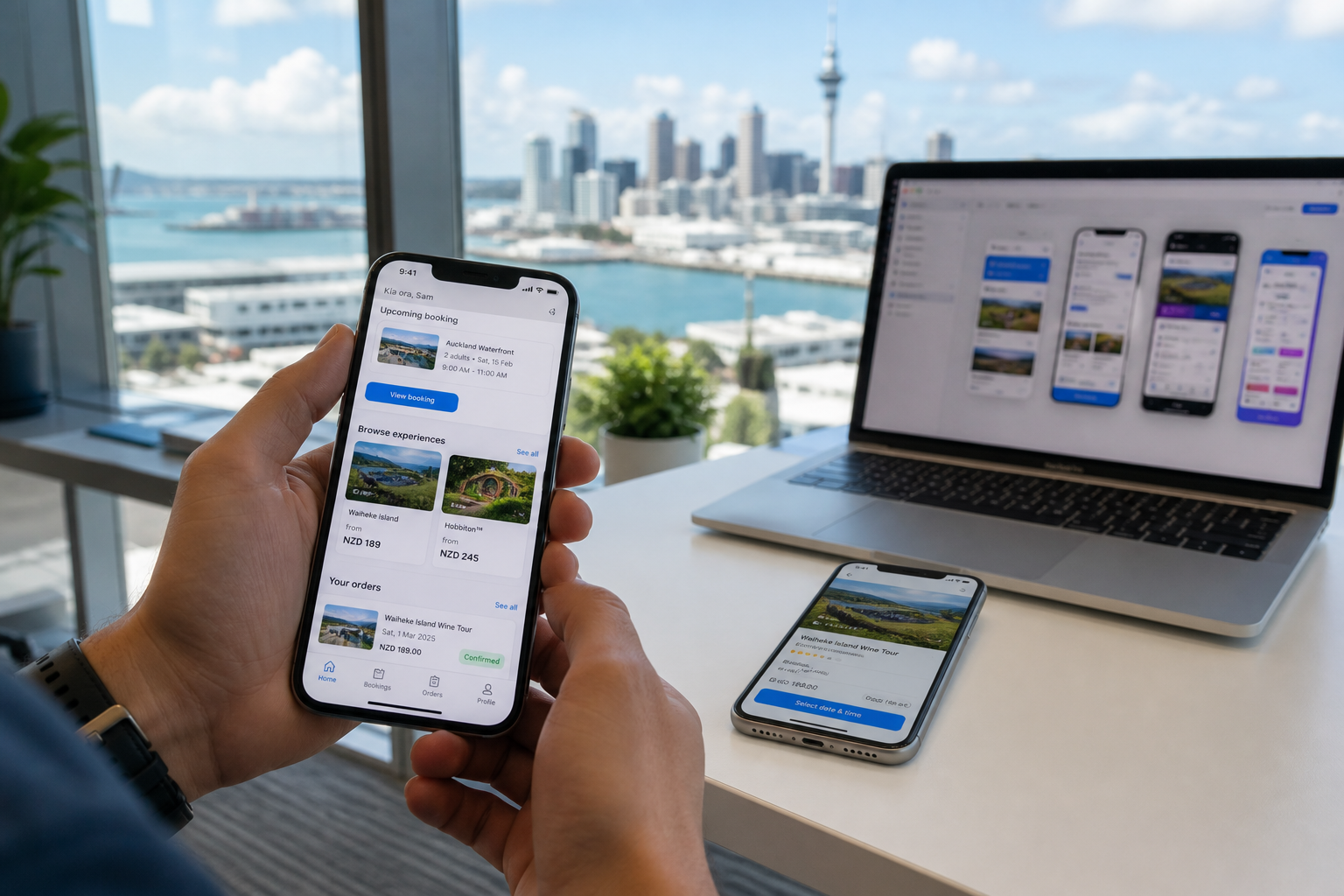
Mobile apps have become an important part of how businesses in New Zealand connect with customers, manage operations, deliver services, and create new digital revenue opportunities. From startups launching new products to established companies modernising existing systems, demand for professional mobile app development in New Zealand continues to grow across industries.
A well designed mobile application can help a business improve customer engagement, automate repetitive processes, simplify bookings and payments, provide personalised experiences, and make services available to users at any time.
However, building a successful app involves much more than writing code. Businesses need to consider the right platform, features, technology stack, user experience, security requirements, development timeline, scalability, and budget before development begins.
In New Zealand, the cost of developing a mobile app can typically range from NZD 10,000 to NZD 80,000+, depending on the complexity of the application, number of features, platforms, integrations, design requirements, and development approach.
This guide explains everything businesses should know about mobile app development in New Zealand, including development costs, technologies, features, timelines, processes, industries, and how to choose the right development partner.
Why Businesses in New Zealand Are Investing in Mobile Apps
Consumer expectations have changed significantly over the past few years. People increasingly expect businesses to provide convenient digital experiences that can be accessed directly from smartphones.
For companies operating in New Zealand, mobile applications can provide a direct and personalised communication channel while improving accessibility and customer experience.
Businesses are investing in mobile apps for several important reasons.
Better Customer Experience
A mobile app allows customers to interact with a business quickly without repeatedly visiting a website or contacting customer support.
Depending on the business model, users can perform activities such as:
- Booking appointments
- Ordering products
- Making payments
- Tracking deliveries
- Managing subscriptions
- Accessing personalised services
- Receiving real time updates
- Contacting customer support
A carefully designed mobile experience can make these interactions faster and more convenient.
Stronger Customer Engagement
Mobile apps allow businesses to maintain ongoing relationships with customers through features such as push notifications, personalised recommendations, loyalty programmes, exclusive offers, and in app messaging.
Instead of depending entirely on search engines or social media platforms to reach customers, businesses can communicate directly with users who have installed their application.
Business Process Automation
Mobile applications are not limited to customer facing services.
Many New Zealand businesses use custom applications to streamline internal processes such as workforce management, inventory tracking, field operations, logistics, reporting, approvals, and employee communication.
For example, a logistics company could use a custom application to manage drivers, track deliveries, update order statuses, and provide live information to customers.
New Revenue Opportunities
Mobile applications can also create additional revenue models for businesses.
Common monetisation strategies include:
- Paid applications
- Subscription plans
- In app purchases
- Marketplace commissions
- Advertising
- Premium memberships
- Service booking fees
Startups in particular can use mobile apps as the foundation of an entirely digital business model.
Improved Brand Visibility
Having an application available on the Apple App Store and Google Play Store can strengthen a company's digital presence.
A professionally developed application can also help businesses create a more consistent brand experience across smartphones, websites, and other digital channels.
Mobile App Development Market in New Zealand
New Zealand has a strong digital economy supported by startups, technology companies, established enterprises, and businesses increasingly adopting cloud based and mobile technologies.
Major business centres such as Auckland, Wellington, Christchurch, Hamilton, and Tauranga continue to see organisations investing in digital transformation.
The demand for mobile solutions extends across both consumer and enterprise applications.
Businesses commonly seek development services for:
- Android applications
- iOS applications
- Cross platform applications
- Enterprise mobile solutions
- Ecommerce applications
- Marketplace applications
- On demand applications
- AI powered applications
- SaaS mobile products
- Internal business applications
The growing adoption of technologies such as artificial intelligence, cloud computing, machine learning, Internet of Things systems, and advanced analytics is also changing how modern mobile apps are built. For a dedicated AI product guide, see AI app development in New Zealand.
Instead of developing simple standalone applications, businesses are increasingly looking for connected platforms capable of integrating with payment systems, CRM software, ERP platforms, cloud services, third party APIs, and existing business infrastructure.
Types of Mobile Apps Businesses Can Develop
Choosing the right type of application is one of the first decisions businesses need to make during mobile app development.
The best approach depends on the target audience, business objectives, features, budget, and expected performance.
Android App Development
Android applications are developed for smartphones and tablets running Google's Android operating system.
Businesses may choose Android development when they want to reach a broad smartphone audience or need applications for devices used by employees, customers, delivery personnel, or field teams.
Android applications can include advanced features such as GPS tracking, payment gateways, push notifications, camera integration, biometric authentication, and third party API integrations.
iOS App Development
iOS app development focuses on applications designed for Apple devices such as the iPhone and iPad.
Businesses targeting Apple users may choose native iOS development when performance, security, interface quality, and integration with Apple's ecosystem are important.
Popular technologies used for iOS application development include Swift and Apple's native development frameworks.
Cross Platform App Development
Cross platform development allows businesses to build applications for Android and iOS using a shared codebase.
Frameworks such as Flutter and React Native are commonly used for this approach.
Cross platform development can be useful for startups and businesses that want to launch on multiple platforms while reducing development time and maintaining a consistent experience.
Enterprise Mobile Applications
Enterprise applications are designed to improve internal business operations.
These applications may connect employees, departments, suppliers, customers, and existing software systems.
Examples include:
- Employee management apps
- Inventory management systems
- CRM applications
- Field service applications
- Warehouse management apps
- Sales management platforms
- Logistics management applications
Enterprise apps usually require stronger security, user permissions, cloud infrastructure, system integrations, and scalability. See our guide to software development in New Zealand for a fuller view of custom platforms.
On Demand Applications
On demand mobile apps connect customers with products or services in real time.
Popular examples include applications for:
- Food delivery
- Grocery delivery
- Taxi booking
- Home services
- Healthcare appointments
- Courier delivery
- Beauty services
- Equipment rentals
These applications often require multiple interfaces, such as customer apps, service provider apps, driver apps, and admin dashboards. Teams building delivery products can also review our food delivery app development work in New Zealand.
Ecommerce and Marketplace Apps
Mobile commerce continues to be an important area of app development.
Businesses can develop ecommerce applications for selling their own products or marketplace applications that connect multiple buyers and sellers.
Common ecommerce features include product catalogues, advanced search, shopping carts, secure payments, order tracking, loyalty programmes, wishlists, customer reviews, and personalised recommendations.
Key Features to Include in a Modern Mobile App
The features required for a mobile application depend heavily on its purpose. However, successful applications generally combine convenience, security, speed, and usability.
Simple User Registration
Users should be able to create accounts without going through an unnecessarily complicated process.
Registration options may include:
- Email signup
- Mobile number signup
- Google login
- Apple login
- Social login
Reducing friction during onboarding can improve user adoption.
Secure Authentication
Applications dealing with sensitive information may require additional authentication measures.
These can include:
- Two factor authentication
- Biometric login
- Face ID
- Fingerprint authentication
- One time passwords
Security requirements should be considered during the early development stages rather than added later.
Push Notifications
Push notifications allow businesses to communicate directly with users.
They can be used for order updates, appointment reminders, promotions, delivery alerts, payment confirmations, account activity, or personalised recommendations.
Notifications should be relevant and carefully managed to avoid overwhelming users.
Online Payment Integration
Applications involving transactions require secure and convenient payment processing.
Depending on the product, developers may integrate debit cards, credit cards, digital wallets, subscription payments, or third party payment providers.
GPS and Location Services
Location functionality is particularly important for delivery, transport, travel, fitness, real estate, and on demand service applications.
GPS features may support:
- Live location tracking
- Nearby service discovery
- Route planning
- Delivery tracking
- Location based recommendations
- Geofencing
Real Time Chat
Messaging functionality allows customers, service providers, support teams, or other users to communicate directly within the application.
Real time communication can be particularly valuable for marketplaces and service based platforms.
Search and Filters
Large applications with many products, services, listings, or content items require effective search functionality.
Advanced filters help users quickly find relevant information based on factors such as location, category, price, rating, availability, or other preferences.
Admin Dashboard
A strong backend administration system is essential for managing a mobile application.
Depending on the platform, administrators may need to manage:
- Users
- Payments
- Orders
- Service providers
- Products
- Content
- Promotions
- Notifications
- Reports
- Support requests
The admin dashboard gives business owners better control over day to day operations.
Analytics and Reporting
Analytics help businesses understand how users interact with their applications.
Important data may include downloads, registrations, active users, conversion rates, purchase behaviour, retention, feature usage, revenue, and user engagement.
This information can guide future product improvements.
Mobile App Development Process in New Zealand
Successful mobile applications usually follow a structured development process rather than moving directly into coding.
At Techanic Infotech NZ, mobile app development projects can be approached through several key stages to reduce risk and create a product that supports both user requirements and business goals.
1. Requirement Analysis
The project begins by understanding the business idea, target market, application goals, users, features, technical requirements, and expected budget.
This stage helps define what needs to be developed and prevents unnecessary features from increasing development costs.
2. Product Planning
Once the requirements are clear, the development team creates a product roadmap.
Planning may include:
- Feature prioritisation
- Platform selection
- User flows
- Technology selection
- Architecture planning
- Development milestones
- Integration requirements
For startups, this stage can also help determine whether launching a minimum viable product first would be more practical.
3. UI and UX Design
Designers create wireframes and application screens based on the expected user journey.
The objective is to make the application visually appealing while ensuring that important actions are easy to understand and complete.
The design process usually covers navigation, buttons, screen layouts, user flows, typography, visual hierarchy, and responsive behaviour. For a deeper look at research, wireframes, prototypes, and design cost factors, see our guide to mobile app design in New Zealand.
4. Mobile App Development
After the designs are approved, developers begin building the application.
This typically includes frontend development, backend development, database creation, API development, third party integrations, and admin panel development.
The exact development approach depends on whether the application is native, cross platform, or part of a larger digital platform.
5. Testing and Quality Assurance
Testing is conducted throughout development to identify technical and usability issues.
Quality assurance may include:
- Functional testing
- Performance testing
- Device testing
- Security testing
- Compatibility testing
- User interface testing
- API testing
Testing across different devices and operating system versions is particularly important before release.
6. App Store Deployment
Once the application is ready, it is prepared for submission to the Apple App Store, Google Play Store, or both.
This stage includes configuring application information, screenshots, descriptions, privacy details, technical settings, and store requirements.
7. Post Launch Support
Mobile app development does not necessarily end after launch.
Applications often require ongoing mobile app maintenance for operating system updates, bug fixes, security improvements, server monitoring, performance optimisation, and new feature development.
Regular updates can help an application remain stable and competitive as user expectations and technologies evolve.
Technologies Used for Mobile App Development
Choosing the right technology stack plays a major role in the performance, scalability, security, and long term maintainability of a mobile application. The technology used depends on the type of app, required features, supported platforms, budget, and future expansion plans.
A professional mobile app development company in New Zealand may use a combination of frontend, backend, database, cloud, and third party technologies to build a complete digital product.
Frontend Technologies
Frontend technologies are responsible for the interface and user experience of the application.
Common options include:
- Swift for native iOS applications
- Kotlin for native Android applications
- Flutter for cross platform app development
- React Native for cross platform applications
Native technologies are generally preferred when an app requires deeper access to device features or maximum platform specific performance. Cross platform frameworks can be a practical option when businesses want to launch Android and iOS apps using a shared development approach.
Backend Technologies
The backend manages application logic, users, data processing, APIs, transactions, and integrations.
Popular backend technologies can include:
- Node.js
- NestJS
- Python
- PHP
- Java
- .NET
The choice depends on application complexity, expected user traffic, integrations, and scalability requirements.
Databases
Applications need secure and reliable databases for storing information such as user profiles, orders, transactions, messages, listings, or application settings.
Common database technologies include:
- PostgreSQL
- MySQL
- MongoDB
- Firebase
- Redis
Database architecture should be designed around the expected scale and type of data being processed.
Cloud Infrastructure
Cloud platforms allow mobile applications to scale more efficiently while supporting services such as storage, hosting, backups, monitoring, and data processing.
Common cloud platforms include:
- Amazon Web Services
- Microsoft Azure
- Google Cloud Platform
A scalable cloud architecture is particularly important for applications expecting large numbers of users or fluctuating traffic.
How Much Does Mobile App Development Cost in New Zealand?
The cost of mobile app development in New Zealand generally depends on the complexity of the product, number of features, supported platforms, design requirements, integrations, backend infrastructure, and development timeline.
For most projects, businesses can expect mobile app development costs to fall within the following range. For a deeper budget breakdown, see our guide to mobile app development cost in New Zealand.
| Package | Price Range | Best For | Key Features |
|---|---|---|---|
| Basic Mobile App | NZD 10,000 – 25,000 | Startups testing an idea or simple customer apps | User registration, login, basic profiles, simple content, contact, push notifications, basic admin panel |
| Mid Level Mobile App | NZD 25,000 – 50,000 | Ecommerce, healthcare, booking, and logistics apps | Online payments, GPS, real time notifications, advanced search, dashboards, bookings, API integrations, analytics |
| Advanced Mobile App | NZD 50,000 – 80,000+ | Marketplaces, enterprise platforms, and AI products | AI/ML, real time tracking, streaming, marketplace features, complex dashboards, IoT and enterprise integrations, high scale cloud |
Basic Mobile App
Estimated cost: NZD 10,000 to NZD 25,000
A basic application usually includes a limited number of screens and straightforward functionality. This range may suit startups testing an idea or businesses building relatively simple internal or customer facing applications.
Mid Level Mobile App
Estimated cost: NZD 25,000 to NZD 50,000
A mid level application includes more advanced functionality, custom user flows, integrations, and a stronger backend. Applications for ecommerce, healthcare, booking, logistics, and other service based businesses often fall within this range.
Advanced Mobile App
Estimated cost: NZD 50,000 to NZD 80,000+
Advanced applications usually involve multiple user types, custom infrastructure, complex integrations, real time functionality, or emerging technologies. Large enterprise platforms and multi app ecosystems can exceed NZD 80,000 depending on the project scope.
Factors That Affect Mobile App Development Cost in New Zealand
There is no single fixed price for developing an app because every project has different technical and business requirements.
Several factors can significantly affect the final development budget.
App Complexity
The more complex the application, the more time is required for planning, design, development, testing, and deployment.
A basic informational application will typically cost less than a marketplace or on demand platform involving multiple users and real time functionality.
Number of Features
Features directly influence development effort.
Adding functionality such as GPS tracking, video calling, AI recommendations, payment processing, real time chat, or advanced analytics can increase the overall budget.
Android, iOS, or Both
Building separate native apps for Android and iOS usually requires more development work than creating a cross platform application with a shared codebase.
Businesses should select their development approach based on audience, product goals, performance needs, and budget rather than cost alone.
UI and UX Design
Custom animations, interactive elements, advanced interfaces, and highly tailored user journeys require additional design and development effort.
Good design remains important because even technically strong applications can struggle if users find them difficult to navigate.
Backend Development
Apps that manage large amounts of data or require multiple user roles usually need a more sophisticated backend.
Backend development can include:
- Databases
- APIs
- Authentication
- Admin dashboards
- Cloud infrastructure
- Notifications
- Reporting systems
The complexity of this infrastructure affects overall cost.
Third Party Integrations
Applications often connect with external platforms such as payment gateways, maps, CRM systems, shipping providers, analytics tools, messaging platforms, and enterprise software.
Each integration requires development and testing.
Security Requirements
Applications operating in sectors such as finance, healthcare, insurance, and enterprise services may require stronger security measures.
Encryption, access controls, secure APIs, audit logs, authentication systems, and compliance requirements can increase development complexity.
Maintenance and Updates
Businesses should also budget for post launch support.
Ongoing costs may include:
- Bug fixes
- Server maintenance
- Security patches
- Operating system compatibility updates
- New features
- Performance improvements
Long term maintenance helps protect the investment made during initial development.
How Long Does It Take to Develop a Mobile App?
The mobile app development timeline depends primarily on the size and complexity of the project.
A general estimate can be:
- Basic apps: 2 to 3 months
- Mid level apps: 3 to 5 months
- Advanced apps: 5 to 8 months or longer
The timeline includes more than coding. Planning, design, backend development, testing, revisions, integrations, and app store deployment all contribute to the final schedule.
Projects can often move faster when requirements are clearly defined before development begins.
Native vs Cross Platform App Development
One of the most common decisions businesses face is whether to choose native or cross platform development.
Both approaches can be suitable depending on the product.
Native App Development
Native applications are developed specifically for one operating system.
Swift is commonly used for iOS, while Kotlin is widely used for Android.
Native development can provide:
- Strong performance
- Better platform specific optimisation
- Deeper access to device features
- Highly customised user experiences
However, developing separate Android and iOS applications may require a larger budget and longer timeline.
Cross Platform App Development
Cross platform development allows developers to build applications for Android and iOS using a shared codebase.
Flutter and React Native are popular frameworks for this approach.
Potential advantages include:
- Faster development
- Shared codebase
- Lower development effort
- Easier maintenance
- Consistent user experience
Cross platform development can be particularly useful for startups, MVPs, ecommerce apps, service applications, and businesses targeting both Android and iOS users.
Popular Industries Investing in Mobile App Development in New Zealand
Mobile applications are being adopted across a wide range of industries in New Zealand.
Healthcare
Healthcare organisations can use apps for appointment scheduling, telehealth, patient communication, medication reminders, and digital health management.
Ecommerce and Retail
Retail businesses can offer product browsing, mobile checkout, loyalty programmes, order tracking, and personalised shopping experiences.
Transport and Logistics
Logistics applications can help manage fleets, optimise routes, track deliveries, monitor drivers, and improve communication between customers and operations teams.
Real Estate
Real estate applications can provide property listings, virtual tours, agent communication, mortgage tools, search filters, and booking functionality.
Tourism and Hospitality
New Zealand's tourism and hospitality businesses can use mobile apps for bookings, travel planning, hotel services, local experiences, digital tickets, and personalised recommendations.
Finance and Fintech
Financial applications can provide mobile banking, budgeting, investment tracking, payments, digital wallets, and financial management tools.
Education
Educational institutions and training providers can create applications for online learning, assignments, video classes, assessments, student communication, and progress tracking.
Agriculture
Agricultural businesses can use mobile applications for farm management, livestock monitoring, equipment tracking, crop management, weather information, and operational reporting.
Benefits of Hiring a Mobile App Development Company in New Zealand
Working with an experienced development partner can help businesses reduce technical risks and create a more structured product development process.
Access to a Complete Development Team
A mobile application typically requires more than one developer.
A complete project may involve:
- Business analysts
- UI and UX designers
- Mobile developers
- Backend developers
- Quality assurance engineers
- Project managers
- DevOps specialists
Working with a development company gives businesses access to multiple specialists under one project structure. If you are deciding between a freelancer, in house hire, dedicated developer, or a full team, see our guide on how to hire mobile app developers in New Zealand.
Better Technology Decisions
Experienced developers can help businesses choose technologies based on performance, cost, scalability, and future requirements.
This can prevent expensive redevelopment later.
Faster Product Development
A structured development process can help teams move efficiently from concept to launch.
Clear milestones, defined responsibilities, and regular testing can reduce unnecessary delays.
Ongoing Support
A reliable development company can continue supporting the application after deployment through maintenance, performance optimisation, security updates, and new feature development.
How to Choose the Right Mobile App Development Company
Choosing a development partner should involve more than comparing prices.
Businesses should evaluate whether the company has the technical skills, communication process, industry knowledge, and post launch support needed for the project.
Consider the following factors. For a broader partner checklist, see software development in New Zealand.
Review Their Portfolio
Look at previous applications and case studies to understand the company's experience.
A relevant portfolio can indicate whether the team has handled similar features, industries, or technical challenges.
Check Technical Expertise
The development company should understand the technologies required for your project, including mobile frameworks, backend systems, databases, cloud infrastructure, and third party integrations.
Understand Their Development Process
Ask how the company handles:
- Requirement analysis
- UI and UX design
- Development
- Testing
- Deployment
- Maintenance
A structured process usually reduces uncertainty during development.
Discuss Communication
Clear communication is essential, especially when development takes several months.
Businesses should understand how often progress updates will be provided and who will be responsible for project communication.
Evaluate Post Launch Support
Ask what happens after the app is released.
Maintenance, bug fixes, operating system updates, security monitoring, and feature enhancements can be critical to long term success.
Why Choose Techanic Infotech NZ for Mobile App Development in New Zealand?
Techanic Infotech NZ provides end to end mobile app development services for startups, growing businesses, and enterprises across New Zealand.
The development process covers product planning, UI and UX design, Android and iOS development, cross platform development, backend engineering, API integrations, testing, deployment, and post launch support.
Businesses can work with Techanic Infotech NZ to build solutions such as:
- Ecommerce applications
- Marketplace apps
- On demand platforms
- Healthcare apps
- Fintech applications
- Logistics solutions
- Enterprise applications
- AI powered mobile products
- Custom business applications
The focus is on building scalable applications that align technology decisions with the actual requirements of the business.
Businesses looking for a reliable mobile app development company in New Zealand can work with Techanic Infotech NZ from initial product planning through launch and ongoing optimisation.
Future Trends in Mobile App Development in New Zealand
The mobile app development landscape continues to evolve as businesses adopt more advanced technologies.
Artificial Intelligence
AI is increasingly being integrated into mobile applications for personalisation, automation, recommendation systems, customer support, analytics, and content generation.
Machine Learning
Machine learning can help applications understand user behaviour and improve recommendations, fraud detection, forecasting, and business intelligence.
Internet of Things
Mobile apps can increasingly act as control centres for connected devices.
IoT applications are particularly relevant to agriculture, logistics, smart buildings, healthcare, and industrial operations.
Cloud Based Applications
Cloud infrastructure allows applications to scale resources based on demand while supporting data storage, processing, backups, and integrations.
Increased Focus on Security
As apps handle more personal and financial information, businesses will need to prioritise secure authentication, encrypted communication, data protection, and access management.
Conclusion
Mobile app development in New Zealand offers businesses an opportunity to improve customer experiences, streamline operations, introduce new services, and build scalable digital products.
The success of an application depends on making the right decisions around features, user experience, technology, security, scalability, and development strategy.
Depending on project requirements, the cost of developing a mobile app can range from approximately NZD 10,000 to NZD 80,000+.
Whether you are a startup validating a new app idea or an established business planning a larger digital platform, working with an experienced development team can help turn the concept into a secure and scalable application.
Techanic Infotech NZ provides complete mobile app development services in New Zealand, from product strategy and design to development, testing, deployment, and ongoing support.
Frequently Asked Questions
1. How much does mobile app development cost in New Zealand?
Mobile app development in New Zealand typically costs between NZD 10,000 and NZD 80,000+, depending on features and complexity.
2. How long does it take to develop a mobile app?
Mobile app development usually takes two to eight months, depending on app complexity, platforms, features, integrations, testing, and design.
3. Which is better, Android or iOS app development?
The best platform depends on your target audience, business goals, budget, required features, and preferred mobile operating system.
4. Is cross platform app development a good option?
Yes, cross platform development helps businesses build Android and iOS apps faster while reducing development and maintenance effort.
5. What technologies are used for mobile app development?
Popular technologies include Flutter, React Native, Swift, Kotlin, Node.js, Python, Firebase, PostgreSQL, AWS, Azure, and Google Cloud.
6. Can Techanic Infotech NZ develop mobile apps in New Zealand?
Yes, Techanic Infotech NZ provides end to end mobile app development services for startups, SMEs, and enterprises across New Zealand.
7. What factors affect mobile app development cost?
App complexity, features, platforms, design, backend development, integrations, security requirements, testing, and maintenance can affect overall development costs.
8. Should startups build an MVP first?
Yes, an MVP helps startups validate their app idea, collect user feedback, reduce initial costs, and improve future development decisions.
9. Is Flutter good for mobile app development?
Flutter can be a strong option for businesses that want to develop Android and iOS applications using a shared codebase while maintaining a consistent user experience.
10. Can an existing website be converted into a mobile app?
Yes. Businesses can build a mobile application around an existing website, backend system, ecommerce platform, or business database. The best approach depends on the current architecture.